Q – To start off the interview – I want to go back to the beginning – your beginning here that is. What inspired you to join Neighborhood House? And what motivated you to stay here for almost 10 years now?
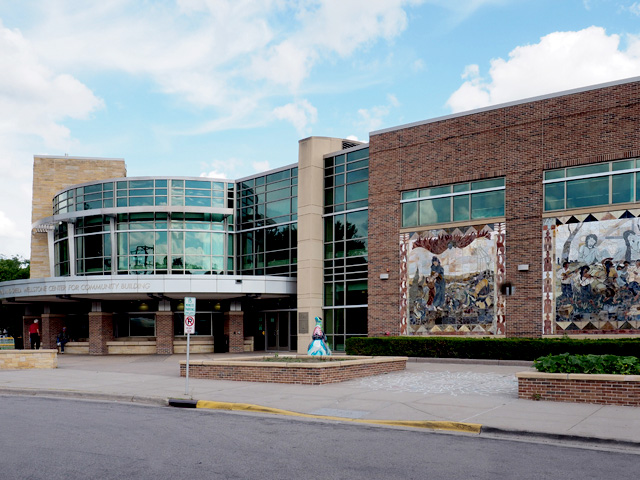
A – I fell in love with the organization when I first encountered it back in the year 2003 when I began working as a campaign director for Neighborhood House and the Wellstone Center build. It felt like becoming the president and CEO was my calling. I’m passionate about how we do things at Neighborhood House, not just what we do.
Q – Can you tell me more about Neighborhood House when you first joined the organization and how that has had an impact on you?
A – When I first joined Neighborhood House, I encountered the value statement at the time, which was “mutual enrichment.” It resonated deeply with me—the idea that everyone has something to teach and learn, give and receive. This value shapes how I interact with the world. Mutual enrichment serves as an antidote to dominant culture, and again it’s not just about what we do, but how we do it that really captured my heart.
Q – Did you always know that this is going to be the place where you retire?
A – No, actually. When I left Neighborhood House after working as the campaign director, it was due to my job ending. The campaign ended, and the role was only a temporary one. I eventually ended up working at Habitat for Humanity as a Vice President, which I enjoyed and thought that might be the role and place I retire from. I stayed in touch with Armando (the former president of Neighborhood House) and his words were always “mi casa es su casa” (my house, is your house). I didn’t aspire to be a president anywhere. However, a mentor raised my sights, and when Armando resigned there were a lot of signs that pointed me back to Neighborhood House and I stepped up to become the president and CEO.
Q – You were at Habitat for several years as well. Were there any people who supported you in this journey to becoming President at Neighborhood House?
A – Absolutely! During my eight years at Habitat, I worked directly with Sue Haigh, the CEO, for the first five years and learned a lot from her. Later, I also reported to Mary Schumacher, who was formerly an executive from Andersen Corporation. Mary opened my eyes to higher level leadership and helped me prepare for being President of Neighborhood House.
Q – After you started working here did you still feel like it was the right place and meant for you?
A – Definitely! Shortly after becoming president, I had a special experience that reaffirmed my sense of belonging.
In 2006 when the Wellstone Center opened, there was a big celebration. My mom and dad drove up from North Carolina for the big grand opening of the building. They brought with them a family punchbowl and donated it to Neighborhood House for use by the organization.
Fast forward to 2014. I was giving a tour with a few people visiting the Wellstone Center and we ended up in one of our conference rooms that holds many important mementos of Neighborhood House history. I noticed my mother’s punchbowl among historic items donated to Neighborhood House. It was such a wonderful surprise to see it on display with important Neighborhood House artifacts. So once again, it was sort of that, sense of wow, I was actually meant to be the president.
I keep telling everybody, I’m not leaving Neighborhood House, I’m changing my relationship.
Q – Looking back on your tenure, what accomplishments are you most proud of?
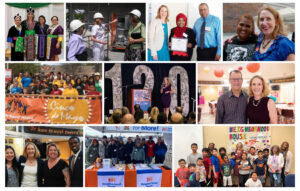
A – The first thing I want to say is there’s nothing that I have done alone. So while there definitely are things I’m proud of, I feel somewhat uncomfortable taking credit for much of it because I never did any of it alone. In fact, I perceive a president’s role as exactly that, not doing it alone.
That being said, throughout my tenure, I’m proud of several accomplishments. Notably, our strategic framework which guided us effectively over the last decade and brought us back to our roots of who and what Neighborhood House is. It also guided us through the COVID-19 pandemic. We emphasized integrated programming and empowering participants to maintain agency over their lives. Additionally, we expanded fundraising capacity, introduced summer camps, and launched the Driver’s Education course. The upcoming Hope in Action campaign and the second center on Montreal also fill me with pride.
Q – Can you tell me more about the integrated programming and what programs are core to Neighborhood House?
A – It serves multiple family members across programs and time, focusing on participant needs and overall well-being. Our core functions include meeting basic needs (especially food and housing), ensuring essential literacy and math skills, and fostering community. We embrace everyone without judgment, welcoming them with respect.
What are some of the biggest challenges you faced during your time as president and CEO? And how did you overcome those challenges?
A – The biggest challenge is balancing the available resources with the needs and goals of the community. We will always prioritize quality programming but sometimes we can’t evolve as quickly as we would like to. Our solutions are around innovation and successful fundraising – and through all of it, we are focused on meeting the needs of the community.
Q – Can you share a memorable moment or even something that really would encapsulate your experience meeting, Neighborhood House?
A – There are so many memorable moments. My deepest and most memorable moments or interactions I’ve had here have been with participants. I absolutely love going to Skills for Schools or Small Steps (part of Neighborhood House’s Parent & Early Childhood Program) and reading with the children. That is just a true pleasure of mine and brings me so much joy.
Another one that stands out was early in my tenure at Neighborhood House. One of the youth staff came to me and told me about a young woman who was attending programming. The participant was a junior in high school, excelled in classes, but she was thinking about dropping out of school. The staff member asked if I would talk with the student. I remember when he introduced me; “Here is Nancy, President of Neighborhood House.” You would have thought it was the President of the United States that she was meeting. The youth worker knew that the student needed to see a compassionate woman leader to help her just believe in herself and believe that she could get wherever she wanted to go. I remember the same girl got an opportunity to go to a summer program in New York. Everyone here rallied around her and helped raise the money she needed to make it happen.
Q – How has the organization kind of evolved or changed under your leadership?
A – We’ve become more focused on who we are and what we do. We have also intentionally designed our programs to work together and consider the family as a whole. We’re now more poised for future growth. Our evolution includes a deeper understanding of how meeting basic needs connects to educational work, jobs, and income, aiming for a thriving future for our participants.
Q – Have you or how have you seen the impact that Neighborhood House has had on the community?
A – I’ve seen the impact on individual participants and families, such as those who attended preschool here and return for summer school even after moving away. It’s like watching someone graduate; they move on and don’t always come back, but they achieve their goals and continue to grow. We are a steppingstone for many as they work towards their own dreams and pursuits.
Q – What legacy does Nancy Brady hope to leave behind?
A – I feel very fortunate to have been a custodian of Neighborhood House as a leader here. My legacy is strengthening and making it responsive to the community, focusing on the whole family’s social and economic well-being, not just individual needs.
Q – What overall advice or wisdom would you give to your peers?
A – That collaboration is key. No one knows everything, so we must rely on and work with others to do good work. Stay connected to the participants and community, balancing strategy with responsiveness. My two guiding mottos are: “Seek first to understand, then to be understood,” and “We seek excellence, not perfection.” These principles help us acknowledge and learn from mistakes. Always ask questions before setting expectations or addressing issues and celebrate successes often.
Q – What advice would you give your successor in leading Neighborhood House?
A – I am very excited about Janet Gracia taking my place as President; I know she is the right leader at the right time. She has spent her entire career on the West Side and knows the community well. Over the last few weeks, I have discovered that Janet is a learner and loves to collaborate; I can think of no better skills to be the leader of Neighborhood House.